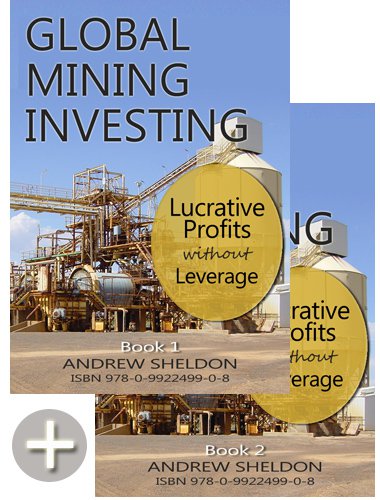
Global Mining Investing $69.95, 2 Volume e-Book Set. Buy here.Author, Andrew Sheldon
Global Mining Investing is a reference eBook to teach investors how to think and act as investors with a underlying theme of managing risk. The book touches on a huge amount of content which heavily relies on knowledge that can only be obtained through experience...The text was engaging, as I knew the valuable outcome was to be a better thinker and investor.
While some books (such as Coulson’s An Insider’s Guide to the Mining Sector) focus on one particular commodity this book (Global Mining Investing) attempts (and does well) to cover all types of mining and commodities.
Global Mining Investing - see store
Tuesday, October 05, 2010
Where to place your money during this recession
Tuesday, April 29, 2008
Bond yields breaking downtrend?
Some interesting developments in markets of late. The real yields on long-winded treasuries have broken their downtrend after the US Federal Reserve engaged in subsidising of the banking system for a time. Does this herald a period of rising interest rates? If you are worried about gold investments, result assured that inflationary pressures will keep Ben Bernacke well behind the curve. I suggest these rates will pull back when new inflation numbers are presented. I think the Fed is not likely to raise rates just yet, and I think these yields will fall once again.Andrew Sheldon www.sheldonthinks.com

Sunday, February 03, 2008
Treasury yields close to historic lows!
------------------------------------------
Andrew Sheldon www.sheldonthinks.com.
Wednesday, August 24, 2005
Debt market outlook
`Investors started to push bonds higher again in afternoon trading as crude oil and natural gas rose to records on concern a storm heading for Florida may threaten production platforms in the Gulf of Mexico`.``There is this underlying demand for fixed income which has restrained the increase in yields'' said Christopher Sullivan, chief investment officer at the United Nations Federal Credit Union in New York, which manages $2 billion in debt. [Doesn`t he have this around the wrong way. Aren`t the high yields attracting demand for US treasuries, pushing up bond prices, thus reducing yields. ie. Supply-demand. I`ll have his job].
Auction
The price of crude oil surged to $67.40 a barrel in New York, up 49percent from a year ago. [How many economists predicted that? Only a few]
Treasuries also benefited as the government sold $20 billion of two-year notes at a yield of 4.014 percent. A category of bidders that includes foreign central banks bought 44 percent of the debt, the most since September. There were $2.28 of bids for every $1 sold, compared with the$2.14 average for the previous 12 sales. [Not surprising that foreign bidders dominated given that US investors are still pooring money into real estate. So expect higher demand for white goods - durables, sustenance of the boom a bit longer, but those US treasury yields are now 4% - not1%, so the US deficit is going to rise greatly. The US is paying more for oil, its paying higher interest on its foreign-held deficit, and the demand for foreign-manufactured white goods will be up. So long as property prices are rising stronger than interest rate payments, US house holds might feel comforted by the high level of economic activity, at least until house prices fall. A few bad numbers could easily kill a Japanese recovery, starting with high oil prices. Mind you the Japanese don`t relyon cars nearly as much as the Americans. Chinese factors do. But oil is likely a bubble too, and like housing, it will go higher. Certainly to$US75, perhaps $US100/bbl if the US Fed start cutting interest rates prematurely to maintain activity. Lastly, US imports will rise (ie. higher deficit) because Americans are paying more for Chinese goods - thanks tothe US deficit. Since the US has no competitive advantage in the Chinese product fields, this does not give the US a competitive benefit...rather Indonesian might benefit over China].``The 4 percent coupon may have enticed some people looking to park moneyin the short end of the curve,'' or shorter- maturity debt, said Rick Klingman, head of U.S. Treasury trading in New York at ABN Amro Inc. The firm is one of the 22 primary dealers of U.S. government securities that are obligated to bid at Treasury auctions.The so-called yield curve may have flattened to the point where two year notes are attractive, Klingman said.Two-year yields rose to within 18 basis points of 10-year yields today,the narrowest since the start of 2001, reducing the incentive for investors to buy a longer-dated, and thus riskier, 10-year security. Thegap has shrunk from 211 basis points in June 2004 as investors pushed up short-term yields in response to the Federal Reserve's 10 interest-rate increases. [An inverted yield curve signals a recession. Every war in recent history has been associated with high oil prices and recession].
Durable Goods
HomesOrders for durable goods tumbled 4.9 percent in July, compared with a riseof 1.9 percent in June, the Commerce Department said. A decline of 1.5percent was expected, according to the median forecast in a survey by Bloomberg News.Later, a government report showed sales of new homes unexpectedly rose toa 1.410 million annual rate last month. A drop to 1.328 million from 1.324million was expected, according to the median estimate of economists surveyed by Bloomberg. [See comments above].
Some strategists predict the rally will be short-lived.Ten-year yields ``just don't make a lot of sense,'' given the Fed is goingto keep raising benchmark rates, said William Prophet, an interest-rate strategist in Stamford, Connecticut, at UBS Securities LLC. The securities are ``definitely rich,'' he said. Ten-year yields will probably rise to about 4.40 percent next month, said Prophet. [Unless demand for long bonds remain strong because of uncertainty, ie. fears of asset erosion].
Saturday, January 29, 2005
Is the US Deficit a problem?
- The deficit is a concern but not a critical problem
- Focus on the trade deficit has ignored the structural changes that the US is going through
- The inadequacy of the national accounts in providing an accurate assessment of the market.
The problems as I see them are the following:
- US Structural issues: The US is not addressing some serious structural flaws in its society. The problems are the over-reliance on hydrocarbons for transportation fuels. The US needs a better rail service. Government intervention into the money supply has resulted in a blow-out in property prices, which is fuelling imports, and a decline in the national savings rate. US corporations are 'slashing & burning' US jobs to move production facilities at home with though thought to the long term impact of those moves. They should remember that ex-employees are also consumers of their products.
There are several elements to the US deficit issue, which arise on its several accounts:
- Merchandise Account: The US has experienced a decline in exports, whilst imports have continued to soar. This 'statistical fact' is taken as evidence that the US has lost its competitive edge. This might serve the interests of US companies seeking concessions, hoping to sway public opinion, but it must be recognised that a great many US companies have moved manufacturing capacity offshore. The best indication of this are Capital Account statistics, which records the flow of investment funds abroad, as well as the income received.
- Services Account: The US has also experienced a decline in its services about, though its far better than the trade account. Regardless, we might expect to see the same movement of jobs offshore as consulting, banking, etc is undertaken from regional offices.
- Capital Account: The Capital Account statistics fail to reveal offshore earnings by US companies. Every year, US corporations are increasing investment in offshore markets, recognising that these markets are where the growth is occuring. Rather than repatriating profits to the US (which would improve the Capital Account), these companies are re-investing profits in additional production capacity. We are not likely however to see this until US demand falls. In this case, we might expect the flow of investment funds out of the US, since markets like China remain firmly export-orientated. Without a strong US market, opportunities for growth in China would decline.
Whilst I don't see the deficit as a risk, the is however solid prospects for higher inflation. But thats another story. A 'gold story'.
Japan Foreclosed Property 2015-2016 - Buy this 5th edition report!
You can view foreclosed properties listed for as little as $US10,000 in Japan thanks to depopulation and a culture that is geared towards working for the state. I bought foreclosed properties in Japan and now I reveal all in our expanded 350+page report. The information you need to know, strategies to apply, where to get help, and the tools to use. We even help you avoid the tsunami and nuclear risks since I was a geologist/mining finance analyst in a past life. Check out the "feedback" in our blog for stories of success by customers of our previous reports.
Download Table of Contents here.
'Buying Philippines Property – Download a free sample chapter!
Buying Philippines Property 2010
- Download the table of contents or buy this 2-volume eBook at our online store for just $US19.95.
Investment Strategy
MY ADVICE is (i) look at a range of market indices and decide upon what level of correction would give you the justification you need to get in & out of the market. It might be a 5-10% retracement or a break of trend. (ii) Diversify if you dont have an intimate knowledge of the company or management. More than 30% in one company is aggressive.
'Buying NZ Property – Download the free sample readings!
The NZ property market is shaping up as one of the most attractive property investment markets for the next few years. High yielding property and the collapse of the NZD make NZ the perfect counter-cyclical investment if you buy right! In addition, there is no capital gains tax, transfer taxes, VAT/GST or wealth taxes in NZ, so rest assured that NZ property is tax-effective! Learn more now!


